Card sorting is a user-research method in which participants organize a set of labeled cards into groups that make sense to them, revealing how they expect information to be categorized and named. It is one of the core techniques of information architecture and user-experience design, used to shape navigation, menus, category labels, and content hierarchies so that a product matches its users' mental models rather than the internal logic of the team that built it. The method is deliberately low-tech — each concept is written on a physical or virtual card, and the participant arranges the cards — yet it rests on a substantial body of research in cognitive psychology and knowledge elicitation (Rugg & McGeorge, 1997; de Quincey & Mitchell, 2021).
Although it is now most closely associated with web and app design, card sorting descends from sorting techniques long used to study how people categorize their world and to elicit experts' knowledge (Rugg et al., 1992). Its enduring appeal is that it surfaces the user's own categories and vocabulary instead of imposing the designer's: the groupings a participant produces are an external trace of the mental model they bring to the content. Card sorts are described as generative when participants form their own categories and evaluative when they sort into categories supplied by the researcher, and the method is frequently paired with complementary techniques such as tree testing to move from how users would group content to whether they can actually find it in a proposed structure.
Types of Card Sort
Card sorts differ along two main dimensions: whether the categories are provided in advance, and how many times participants sort the same material. Three variants are standard (de Quincey & Mitchell, 2021).
Open Card Sort. Participants sort the cards into groups they create and name themselves. This is a generative, exploratory approach used when designing a new information architecture, because it reveals how users naturally categorize content and what labels they expect.

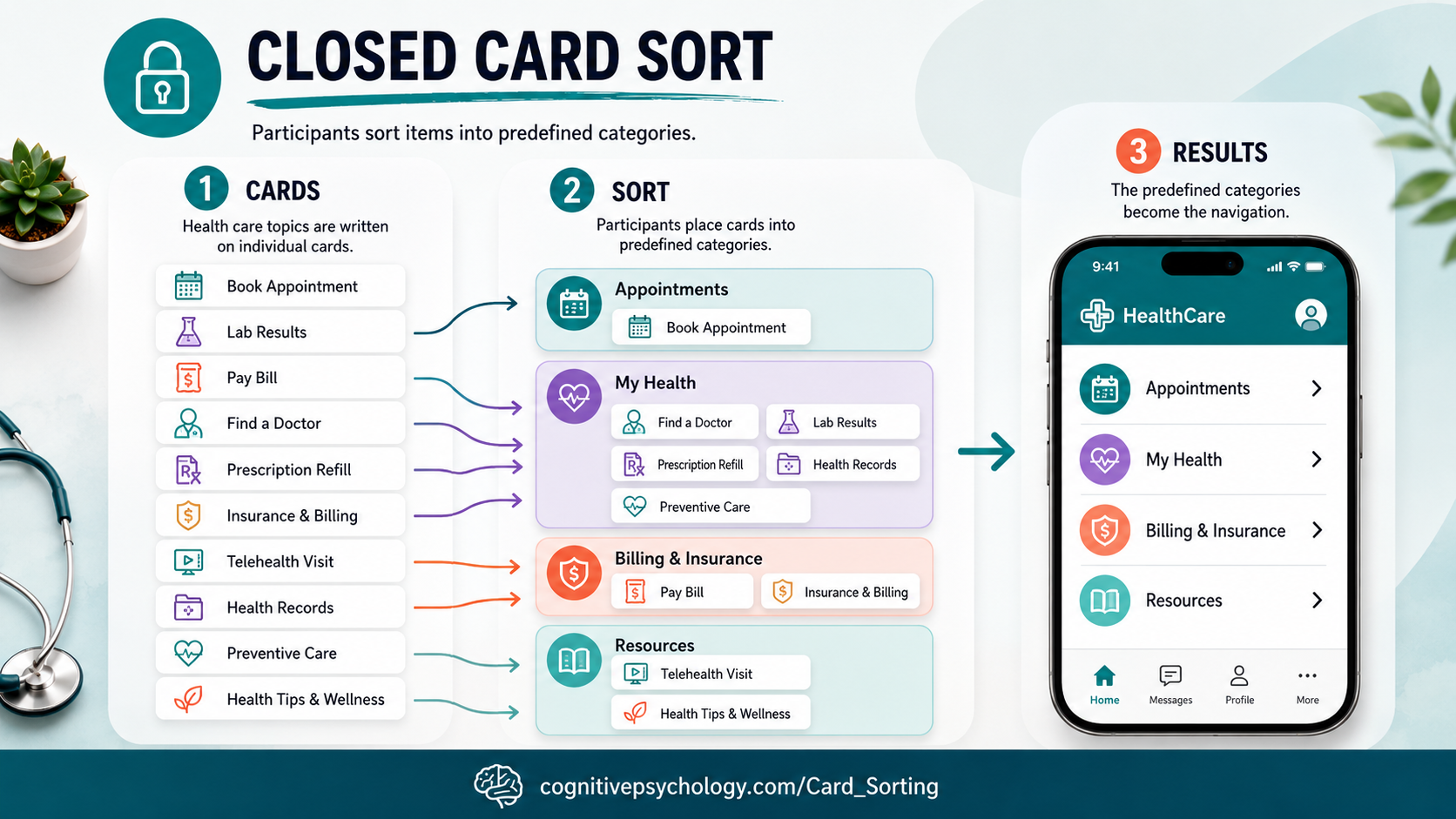
Closed Card Sort. Participants sort the cards into categories the researcher has defined in advance. This is an evaluative approach used to test whether a proposed or existing structure matches users' expectations.
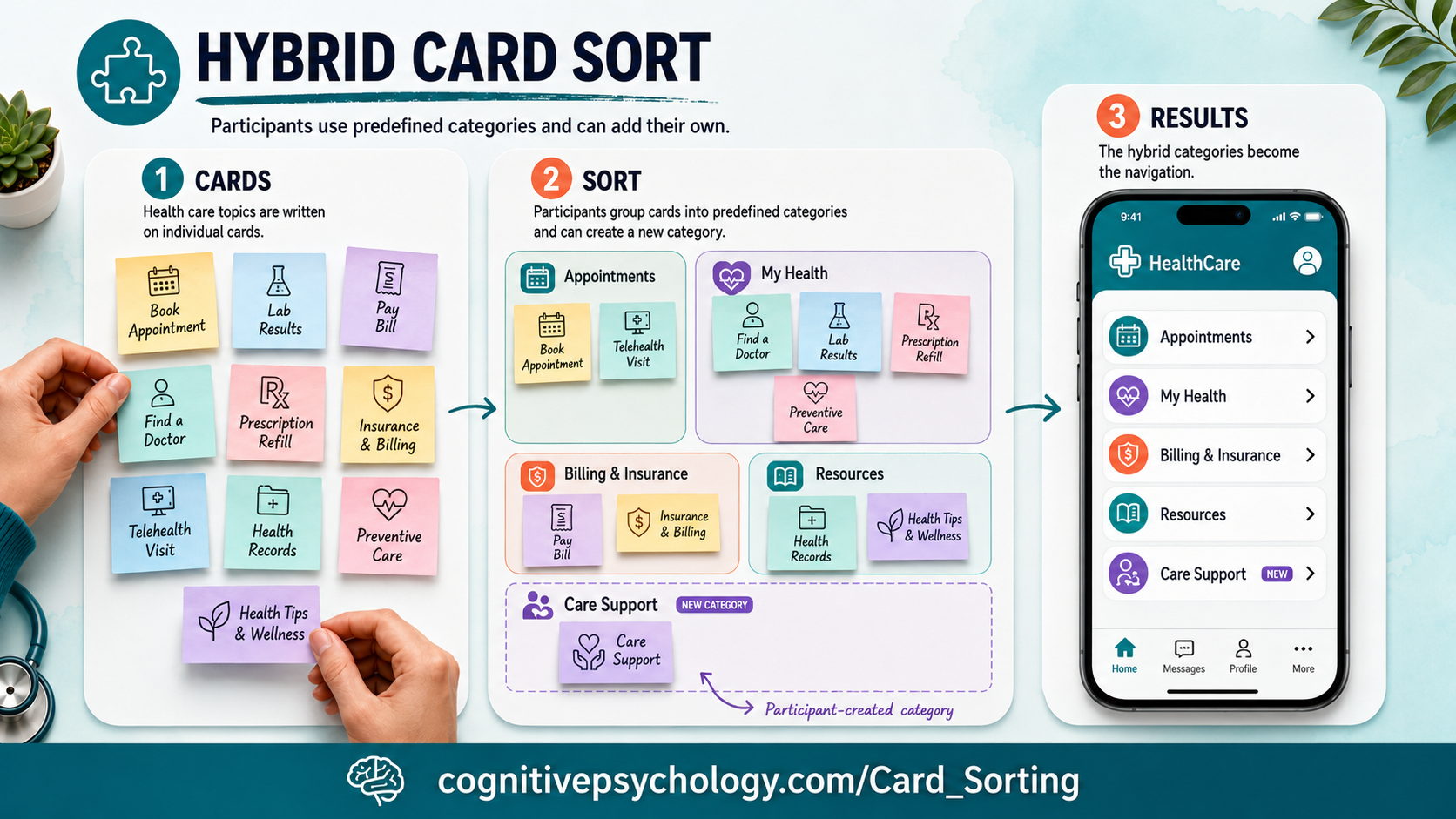
Hybrid Card Sort. Participants sort into predefined categories but may also create their own, balancing the open-ended discovery of an open sort with the structure-validation of a closed sort.
A distinct variation, repeated single-criterion sorting, asks each participant to sort the same set of cards several times, using a different self-chosen criterion on each pass until they run out of criteria. Rather than a single grouping, this elicits the full range of constructs a person uses to make sense of the material, and it is the variety analyzed in detail in the foundational tutorial on the technique (Rugg & McGeorge, 1997; de Quincey & Mitchell, 2021). Card sorts can be run in person or online, moderated or unmoderated, and with individuals or small groups; online tools have made remote, unmoderated sorting with larger samples routine, which in turn raises the analytical challenge of aggregating many divergent sorts.
How a Card Sort Is Conducted
A card sort follows a simple, repeatable procedure:
- Select the content items and write one concept per card, presenting them in randomized order so the arrangement does not itself suggest groupings.
- Brief the participant, emphasizing that there are no right or wrong answers and that the goal is to capture how they think the material fits together.
- Ask the participant to sort the cards into groups; in an open sort, they also name each group.
- Optionally have participants think aloud, turning the sort into a concurrent verbal protocol that exposes the reasoning behind their choices.
- Record the groupings and labels, then debrief to clarify ambiguous or surprising placements.
Because card sorting is primarily a qualitative, generative method, a relatively small number of participants is often enough to reveal stable groupings. A widely cited study of sample size found that the groupings produced by around 20–30 participants already correlate strongly with those from a much larger sample, making that range a common rule of thumb (Tullis & Wood, 2004). Larger samples are common in online studies and shift the emphasis toward quantitative aggregation of the results.
Analyzing Card Sort Data
The central difficulty of card sorting is not collecting the data but making sense of it — especially for open sorts with many participants, where each person may produce idiosyncratic groups and labels. Fincher and Tenenberg (2005) distinguish two broad families of analysis: semantic methods, which require the researcher to interpret the meaning of the groups and labels participants create, and syntactic methods, which work purely from the structure of the sorts and can therefore be automated. Common quantitative outputs include co-occurrence or similarity matrices — how often each pair of cards is placed together — and dendrograms produced by hierarchical cluster analysis, which display the nested structure of the groupings. Repeated single-criterion sorts are typically analyzed through such co-occurrence measures (Rugg & McGeorge, 1997). The practical conclusion is that even large data sets can be analyzed meaningfully by combining interpretive and computational approaches (Fincher & Tenenberg, 2005).
Cognitive Basis
Card sorting works because it externalizes categorization — the cognitive process of grouping items by shared features or function. The groups a participant forms are a visible expression of the mental model and stored category knowledge they bring to a domain, drawing on schemas and the organization of semantic memory. The task also exploits the asymmetry between recognition and recall: arranging cards that are already in front of you is far easier and more reliable than generating an organizational scheme from memory, so participants can express structure they could not articulate spontaneously. Because the categories come from the user rather than the designer, a card sort makes tacit organizing principles available for inspection — exactly what is needed to design an information architecture that feels intuitive.
Applications in UX and Information Architecture
In UX and UI design, card sorting is used chiefly to design and evaluate information architecture: the structure of site navigation, menus, category labels, and content hierarchies. It has been applied to elicit the quality attributes people use to judge web pages (Upchurch, Rugg, & Kitchenham, 2001), to inform the information architecture of library and institutional websites (Faiks & Hyland, 2000), and, more recently, to design faceted navigation for digital services such as music libraries (de Quincey & Mitchell, 2021). The method has also been adapted to remain usable by people who cannot see the cards: Álvarez Robles and colleagues (2019) evaluated an interaction design that lets blind participants perform a card sort through a screen reader.
Because a card sort is generative — it reveals how users would group content — it is often paired with the evaluative method of tree testing, which checks whether users can actually find items in a proposed hierarchy. Both sit within the wider method set described on the UX/UI page, alongside related discovery and evaluation techniques.
Strengths and Limitations
- User-centered and low-cost. Card sorting surfaces users' own categories and vocabulary with little equipment or expense, and most participants find the task easy and even enjoyable (Rugg & McGeorge, 1997).
- Flexible. Open, closed, hybrid, and repeated single-criterion variants let the method serve both generative design and evaluation, in person or online.
- Insight, not a finished design. A card sort reveals how users group content but does not itself produce the final architecture; expert judgment is needed to reconcile divergent sorts into a workable structure (Fincher & Tenenberg, 2005).
- Analysis can be demanding. Open sorts with many participants generate divergent, idiosyncratic data whose aggregation requires careful semantic or computational analysis (Fincher & Tenenberg, 2005).
- Sorting is not finding. Grouping cards on a table differs from navigating a live interface, which is why card sorting is complemented by task-based methods such as tree testing.
Key Researchers
The following researchers have made foundational contributions to card sorting as a UX and information-architecture method, ordered alphabetically by surname.
- Ed de Quincey — Professor of Computer Science, School of Computer Science and Mathematics, Keele University; brought card sorting into contemporary UX practice, including repeated single-criterion sorting for the information architecture of digital services (de Quincey & Mitchell, 2021).
Google Scholar · Keele University - Sally Fincher — Emerita Professor of Computing Education, School of Computing, University of Kent; advanced the rigorous analysis of card-sort data, distinguishing researcher-interpreted semantic analysis from automatable syntactic methods (Fincher & Tenenberg, 2005).
Google Scholar · University of Kent - Barbara Kitchenham — Professor Emerita of Software Engineering, School of Computer Science and Mathematics, Keele University; applied card sorts to elicit web-page quality attributes, extending the method to web and UX evaluation (Upchurch, Rugg, & Kitchenham, 2001).
Google Scholar · Keele University - Peter McGeorge — Professor, School of Psychology, University of Aberdeen; co-author of the foundational tutorial that established the procedure and analysis of card sorts in the research literature (Rugg & McGeorge, 1997).
Google Scholar · University of Aberdeen - Gordon Rugg — Head of the Knowledge Modelling Group, School of Computer Science and Mathematics, Keele University; formalized card sorting as a structured knowledge-elicitation and information-architecture method through the foundational sorting-techniques tutorial and comparison studies (Rugg et al., 1992; Rugg & McGeorge, 1997).
Keele University - Josh Tenenberg — Professor, School of Engineering & Technology, University of Washington Tacoma; co-developed methods for making sense of card-sort data, including the distinction between semantic and syntactic analysis of large data sets (Fincher & Tenenberg, 2005).
Google Scholar · University of Washington Tacoma
References
| 1 | Álvarez Robles, T. J., Álvarez Rodríguez, F. J., Benítez-Guerrero, E., & Rusu, C. (2019). Adapting card sorting for blind people: Evaluation of the interaction design in TalkBack. Computer Standards & Interfaces, 66, 103356. https://doi.org/10.1016/j.csi.2019.103356 |
| 2 | de Quincey, E., & Mitchell, J. (2021). Card sorting for user experience design. Interacting with Computers, 33(4), 442–457. https://doi.org/10.1093/iwc/iwac002 |
| 3 | Faiks, A., & Hyland, N. (2000). Gaining user insight: A case study illustrating the card sort technique. College & Research Libraries, 61(4), 349–357. https://doi.org/10.5860/crl.61.4.349 |
| 4 | Fincher, S., & Tenenberg, J. (2005). Making sense of card sorting data. Expert Systems, 22(3), 89–93. https://doi.org/10.1111/j.1468-0394.2005.00299.x |
| 5 | Rugg, G., Corbridge, C., Major, N. P., Burton, A. M., & Shadbolt, N. R. (1992). A comparison of sorting techniques in knowledge acquisition. Knowledge Acquisition, 4(3), 279–291. https://doi.org/10.1016/1042-8143(92)90019-W |
| 6 | Rugg, G., & McGeorge, P. (1997). The sorting techniques: A tutorial paper on card sorts, picture sorts and item sorts. Expert Systems, 14(2), 80–93. https://doi.org/10.1111/1468-0394.00045 |
| 7 | Upchurch, L., Rugg, G., & Kitchenham, B. (2001). Using card sorts to elicit web page quality attributes. IEEE Software, 18(4), 84–89. https://doi.org/10.1109/MS.2001.936222 |